Skip to content
4.8 from 1,000+ reviews

Same-day dispatch order by 2pm

FREE delivery over £50 Royal Mail TrackedWhere's my order?

Trade counter & expert advice Aintree, Liverpool

Your cart is empty

Continue shopping
0Cart(£0.00)

Window Restrictors: Types, How Far They Open and How to Fit Them

The short answer

A window restrictor stops a window opening more than a set distance. There are four main types: cable, hook (also called a safety catch), sliding and restricted hinges. Cable restrictors are by far the most popular: about 6 in 10 of the window restrictors we sell.

For child safety, the window should open no more than 89mm. Choose a restrictor tested to the child-resistant standard BS EN 16281.

For fresh air and security, a key-locking cable restrictor lets you leave a window part-open. Most take 10 to 15 minutes to fit.

Window restrictors are also called window safety catches, window limiters or child locks. They let you open a window for air without it swinging wide open, which helps stop a child falling and makes it harder for someone to climb in.

We sell almost 10,000 a year, to homeowners online and to window fitters at our trade counter. Here's how to choose the right one, based on what our customers actually buy.

Already know which type you need? Jump to our picks, or go straight to how to fit one.
The window restrictors we recommend

Our pick for most windows
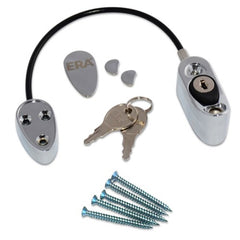
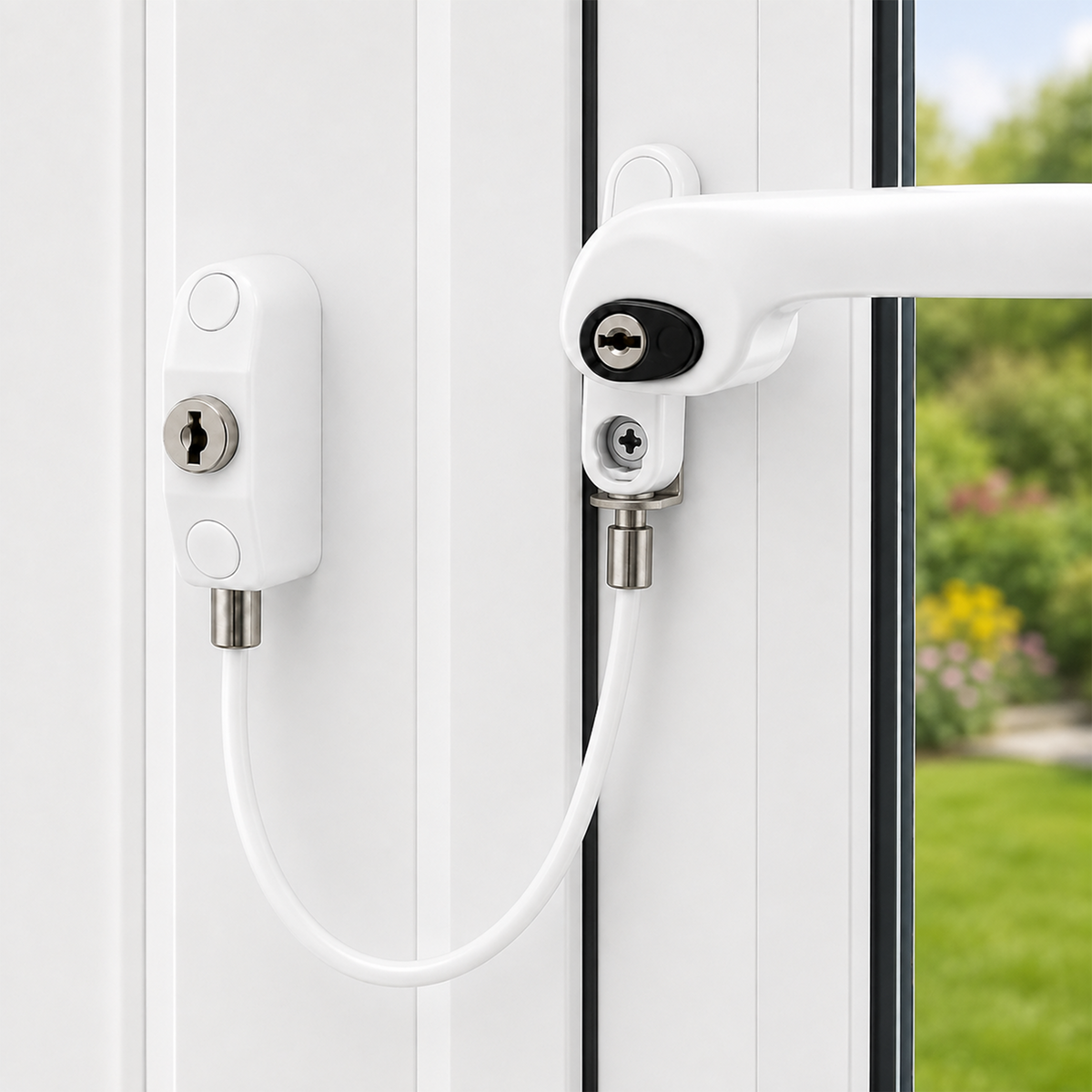
  • Bracket fits behind your existing window handle
  • 230mm locking steel cable, with 2 keys
  • Tested to a 100kg (M1) load force
Choose this if: you want a key-locking restrictor with a neat fit on uPVC, timber or aluminium windows.
View the restrictor
Best for child safety
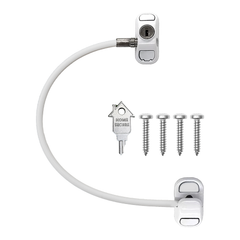
  • Child-resistant to BS EN 16281
  • Grade 3 impact resistance (BS EN 13126-1)
  • Key locking with push-button release, in 4 finishes
Choose this if: you're fitting restrictors to stop a child falling, or for a rental property.
View the restrictor
Best for fresh air
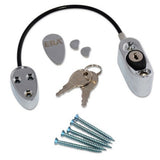
Home Secure cable restrictor 5.0 (1 reviews) £6.99
  • Locks a window part-open, around 18cm
  • 20cm coated steel cable with key release
  • Our best seller: over 5,300 sold last year
Choose this if: you want to leave windows open for air without leaving them unsecured.
View the restrictor

Not sure which fits your windows?

Email a photo of your window and frame to info@homesecureshop.co.uk and we'll tell you which restrictor fits and where to fit it.

  • 4.8 from 1,000+ reviews
  • Almost 10,000 window restrictors sold in the last 12 months
  • Same-day dispatch, order by 2pm
  • Trade counter in Aintree, Liverpool

Compare our window restrictors

FeatureCable restrictor with handle bracketLocking cable restrictorHome Secure cable restrictor
Our verdictOur pick for most windowsBest for child safetyBest for fresh air
Safety testingTested to 100kg (M1) loadTested to BS EN 16281Not tested to a standard
Customer ratingNewNew★ 5.0 (1)
Restricted openingSet by where you fit itSet by where you fit itAbout 18cm
FittingBracket behind handle, or fixing plateScrew fixScrew fix
Price£7.99From £14.99£6.99
ShopViewViewView

Swipe the table sideways to compare.

Our tip

Fit the restrictor on the opening edge of the window, the side opposite the hinges, and measure the gap at its widest point once it's on. If the window is in a child's bedroom, the gap must be no more than 89mm. Many homes use both: a locking restrictor on windows a child can reach, and cable restrictors on the windows you like to leave open.

The Home Secure team

Which window restrictors do people actually buy?

Window restrictors sold by type, last 12 months

Cable61%
Hook (safety catch)19%
Sliding19%

Based on 9,934 window restrictors sold through homesecureshop.co.uk, Amazon, eBay and our Aintree trade counter, October 2025 to October 2026. Restricted hinges are counted with window hinges, not here.

Who buys what is just as telling. Most cable and sliding restrictors are bought online, mainly through Amazon. Hook restrictors are the trade's choice: 6 in 10 of them are sold at our counter to window fitters, because they fit neatly into the groove of a uPVC window.

The single most popular restrictor is our Home Secure window cable restrictor, with over 5,300 sold in a year.

What are the different types of window restrictor?

Type How it works Fitting Best for
Cable A short steel cable joins the window to the frame and locks into a lock body with a key. Unlock it to open the window fully. Screws to the frame and the window. Fits uPVC, timber and aluminium. Fresh air with security, and child safety if tested to BS EN 16281
Hook (safety catch) A metal arm in the window's groove catches as the window opens. It re-engages by itself when you close the window. Screws into the "euro groove" around the edge of a uPVC window. Left- and right-hand versions. A neat, hidden fit on uPVC windows
Sliding A slide stops the window at around 7cm. Press and slide it to release. Sticks on with adhesive tape, or screws on. Rented homes, or where you can't drill
Restricted hinges The window hinge (friction stay) itself only lets the window open part-way. Replaces the existing hinges. When the hinges need replacing anyway

Hook restrictors stop the window at about 100mm, and we sell them at our Aintree trade counter. Our fixed restrictor with key release also fits in the euro groove. It stops the window at around 10cm until you release it with the key. For restricted hinges, see our restricted window hinges.

Fitting for child safety?

Our locking cable restrictor is tested to the child-resistant standard BS EN 16281. From £14.99.

View the restrictor

How far should a window restrictor let a window open?

The British Standard for window restrictors, BS EN 13126-5, sets two limits:

  • 89mm for child safety. If you're fitting restrictors to stop a child falling, the window must not open more than 89mm.
  • 100mm for general safety. The Health and Safety Executive also uses 100mm as the limit for windows in care homes and similar buildings.

How our restrictors compare:

Restrictor Opening Tested to
Locking cable restrictor Set by where you fit it BS EN 16281 (child-resistant) and BS EN 13126-1 Grade 3 impact
Cable restrictor with handle bracket Set by where you fit it (230mm cable) 100kg (M1) load force
Home Secure window cable restrictor Around 18cm Not tested to a standard. For fresh air, not child safety
Fixed restrictor with key release Around 10cm BS 6375 Part 2:2009
Sliding window restrictor Around 7cm Not tested to a standard

Whichever you choose, measure the gap at its widest point once it's fitted.

Which window restrictor should I choose?

Many homes use more than one: a locking restrictor on upstairs windows a child can reach, and cable restrictors on the windows you like to leave open. On inward-opening windows and doors, a sash jammer adds extra security on top.

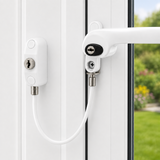
Fits behind your window handle

Our cable restrictor's bracket uses your handle's own screws, with a fixing plate included too. £7.99.

View the restrictor

How do I fit a cable window restrictor?

You'll need the restrictor with its screws and keys, a screwdriver, a drill with a small bit for pilot holes, a tape measure and a pencil. One part, the lock body, goes on the frame. The other, the end of the cable, goes on the part of the window that opens.

  1. Choose the spot. Fit the restrictor on the opening edge of the window, the side opposite the hinges. Make sure both parts sit on a flat part of the frame and window, not on the rubber seals or the strip that holds the glass in.
  2. Fit the cable end. Screw the end of the cable to the opening part of the window using the screws supplied. Drill a small pilot hole first so the uPVC doesn't split. On our cable restrictor with handle bracket, the bracket goes behind your window handle instead: take the handle screws out, put the bracket behind the handle and refit the handle with the same screws.
  3. Set the gap. Lock the cable into the lock body. Open the window to the gap you want and hold the lock body against the frame with the cable pulled straight. For child safety, the gap must be no more than 89mm. Mark the screw holes with a pencil.
  4. Fit the lock body. Drill pilot holes at your marks and screw the lock body to the frame. Don't overtighten the screws.
  5. Test it. Open the window as far as it goes and measure the gap at its widest point. Then unlock and release the cable to check you can open the window fully.

On our locking cable restrictor, you lock it by pushing the cable into the lock body and turning the key. To release it, unlock it with the key and press the button.

How do I fit a self-adhesive sliding restrictor?

  1. Clean the surfaces. Wipe the frame and window where the restrictor will go, then let them dry fully. The adhesive won't hold on dust or grease.
  2. Position it. Close the window and hold the restrictor in place on the opening edge, following the instructions in the box. Mark its position with a pencil.
  3. Stick it down. Peel off the backing and press each part firmly in place for at least 30 seconds.
  4. Let it set. If you can, leave it for 24 hours before using it, so the adhesive reaches full strength.
  5. Test it. Open the window and check it stops at around 7cm, then check the release works.

Screws are also supplied, so you can screw it on instead if you prefer a permanent fix.

Where should I fit window restrictors?

  • Upstairs windows a child can reach. These are the most important, especially in bedrooms. Use a restrictor that opens no more than 89mm.
  • Windows with furniture underneath. A bed, sofa or chest of drawers under a window makes it easy for a child to climb up. Move furniture away where you can.
  • Ground-floor windows you leave open. A key-locking cable restrictor lets you leave a window open for air without it being opened further from outside.
  • Kitchens and bathrooms. Rooms you often want to air are a good fit for a cable restrictor too.

Can I fit a restrictor to a fire escape window?

Yes, but you must be able to open the window fully, quickly, in a fire. On a key-locking restrictor, keep the key near the window, out of a child's reach, and make sure every adult in the house knows where it is. Choose a restrictor that releases quickly, like our locking cable restrictor with its push-button release.

How do I check a window restrictor is working?

  • Check the gap after fitting. Measure it at the widest point.
  • Push the window firmly when it's at the restricted position. It shouldn't move further.
  • Every few months, check the screws are tight and the cable isn't frayed or kinked.
  • Replace a restrictor if the cable is damaged or the lock no longer holds.

Not sure which restrictor fits your windows? Email a photo of your window and frame to info@homesecureshop.co.uk, call us on 0151 521 8089, or bring a photo to our Aintree trade counter.

See every restrictor we stock

Cable, sliding and key-locking restrictors for uPVC, timber and aluminium windows.

Shop window restrictors

FAQ

There are four main types. Cable restrictors join the window to the frame with a short steel cable that locks with a key. Hook restrictors (safety catches) fit in the groove of a uPVC window and re-engage by themselves when you close it. Sliding restrictors can stick on with no drilling. Restricted hinges replace the window's hinges. Cable restrictors are the most popular, at about 6 in 10 of the window restrictors we sell.

For child safety, no more than 89mm, which is the limit in the British Standard BS EN 13126-5. The same standard allows 100mm for general safety. Measure the gap at its widest point once the restrictor is fitted.

It depends on the window and why you're fitting it. A hook restrictor fits neatly in the groove of a uPVC window and re-engages every time you close the window, which is why window fitters buy most of ours. It stops the window at about 100mm, so it's above the 89mm child-safety limit. A cable restrictor fits uPVC, timber and aluminium windows and locks with a key. For child safety, choose one tested to BS EN 16281, such as our locking cable restrictor.

Yes. A key-locking cable restrictor like our Home Secure window cable restrictor locks the window part-open, around 18cm, so air can get in but the window can't be opened further from outside. It's not for child safety, as the gap is wider than 89mm.

Yes. Our sliding window restrictor sticks on with self-adhesive pads, so it's a good choice for rented homes. Clean the frame first and, if you can, leave it 24 hours before use so the adhesive reaches full strength.

Yes, but you must be able to open the window fully and quickly in a fire. Choose a restrictor that releases easily, keep any key near the window but out of a child's reach, and make sure every adult in the house knows where it is.